Video Space Detection Solution for Multi-Level Car Parks
Area-based space management, no cross-floor overcounting and real-time availability guidance
1. Overview
This general-purpose smart-parking solution is designed for indoor multi-level car parks with two or more floors and is not limited to a specific floor count.
Its core purpose is to correct availability-count errors caused by vehicles passing through a floor without actually parking there.
Applicable scenarios
Indoor multi-level car parks with 2 to N floors
Independent entry and exit lanes on each floor
Sites requiring real-time availability guidance for every floor
Optional integration with DingTalk or WeChat Mini Programs to push availability data
Typical example
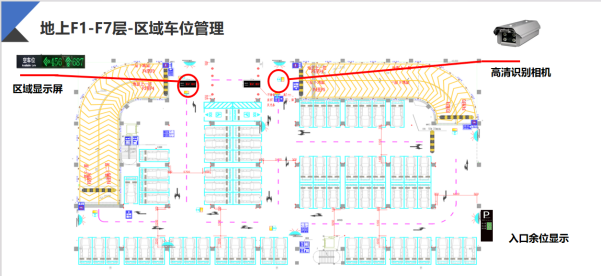
In a four-floor indoor car park, two HD license plate recognition cameras are installed at each floor's entry and exit, for a total of eight cameras,
with one large availability display at the first-floor entrance. The same logic can be adapted to any number of floors.
Solution advantages
Cross-floor counting algorithm solves the core availability-statistics problem in multi-level car parks.
General architecture expands smoothly from two floors to any number of floors.
Real-time availability guidance reduces search time and improves the parking experience.
Open interfaces support customised DingTalk and WeChat Mini Program integration.
Cloud architecture supports remote management and data analysis.
2. Overall system architecture
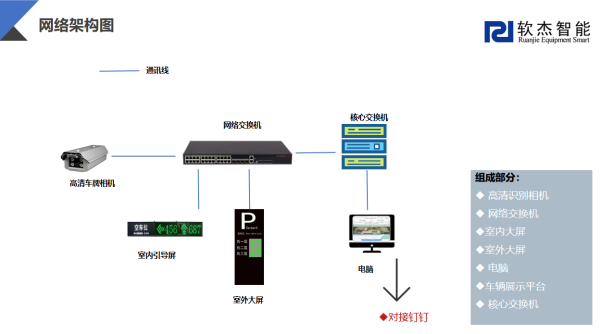
The system uses four layers: front-end sensing -> network transmission -> platform processing -> terminal display.
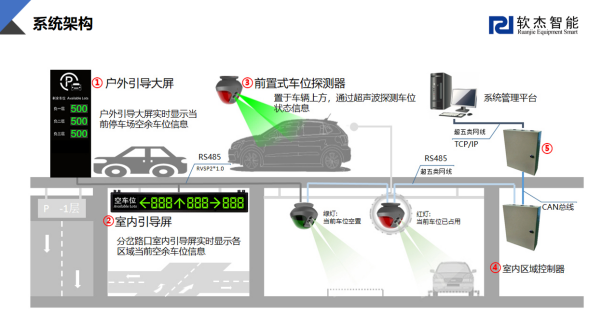
Front-end sensing layer: HD license plate recognition cameras at entrances and exits,
availability displays and fill lights collect plates and show space information.
Network transmission layer: Wired or wireless networks send front-end data to the central server
with low latency and high reliability.
Platform processing layer: Deployed in the central server room or cloud, with a plate-recognition engine,
cross-floor counting engine, database and Web management back end.
Terminal display layer: Availability displays, the Web management interface and DingTalk/WeChat Mini
Programs provide information to users and administrators.
2.2 System Architecture Diagram
The system architecture is shown below:
System components
License plate recognition system: automatically recognises and records entering and exiting vehicles.
Cross-floor counting system: core algorithm engine for passage judgement and availability statistics.
Availability-guidance system: displays each floor's availability in real time.
Data-management system: provides back-office management, analysis and report export.
3. Cross-floor intelligent counting logic
In a multi-floor car park, a vehicle passes through other floors before reaching its destination. The solution temporarily deducts a space when the vehicle passes,
restores it after passage is confirmed and confirms the deduction only when the vehicle finally parks.
Example: vehicle finally parks on 3F
Entry on 1F: The vehicle enters through the first-floor entrance. The camera records Plate_A at time T1,
the platform stores the entry time and 1F availability decreases by one while the system waits for a parking decision.
Passage to 2F: The vehicle passes the 1F exit and 2F entrance. The system identifies passage, restores 1F availability,
deducts one space from 2F and records the current floor as 2F.
Passage to 3F: The vehicle passes the 2F exit and 3F entrance. The system restores 2F availability, deducts one space from 3F and records 3F as the current floor.
Final parking confirmation: The vehicle passes the 3F exit and does not appear at the 4F entrance within the configured time.
The system determines that it has parked and confirms the deduction from 3F.
Exit: When the vehicle leaves the car park, availability on the confirmed parked floor is restored. If the vehicle passes through without parking and exits,
availability on all affected floors is restored.
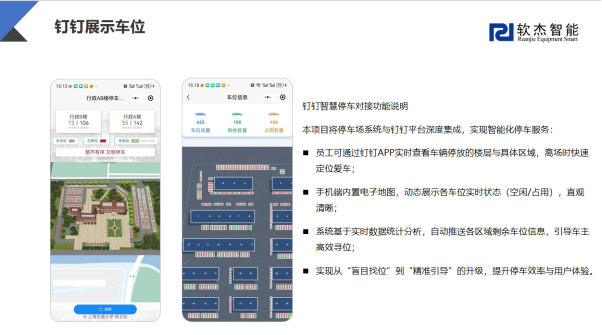
DingTalk and WeChat Mini Program integration
Through an open API, the solution can push each floor's availability data to DingTalk or a WeChat Mini Program. Users can check every floor in real time and plan their route.
4. After-sales service
Hardware warranty: one year. The software system receives regular upgrades and maintenance.
Remote operations and maintenance: 24/7 support for fast fault location and resolution.
On-site service: one-minute telephone response in Shanghai, on-site arrival within one hour for nearby projects and within 48 hours nationwide.
Regular inspections: remote system health checks at scheduled intervals.
Training: free administrator training covering system operation, common fault handling and report queries.