Campus Smart Mobility and Emergency Command System Solution
Problem-led, needs-led, outcome-led: advancing the digital transformation of campus safety
一. Campus traffic problems and challenges
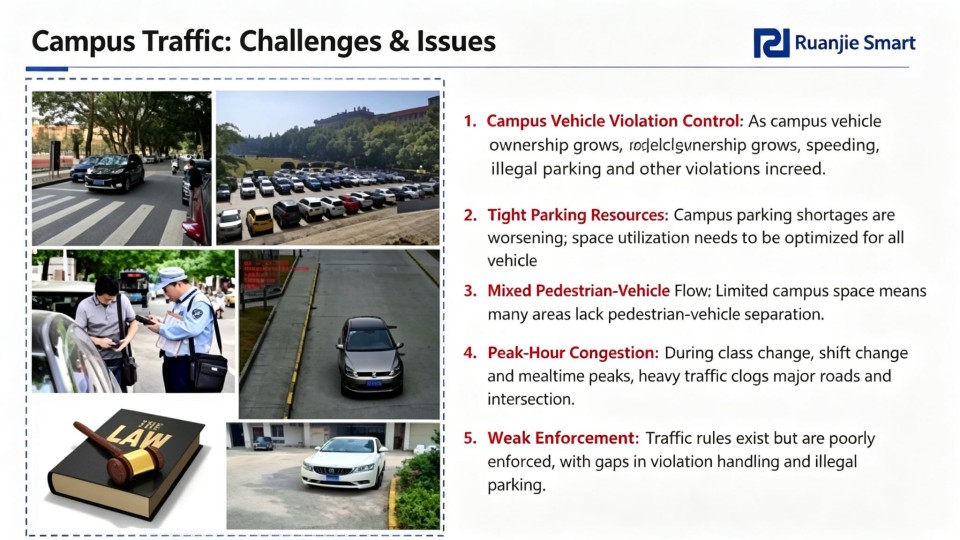
As the number of vehicles on campus continues to grow, traffic management faces five core challenges:
Difficult vehicle-violation control: Speeding and disorderly parking are frequent and affect campus safety and order.
Tight parking resources: Parking difficulty is becoming more serious and space utilisation needs to improve.
Significant mixing of people and vehicles: Limited campus space makes complete separation difficult.
Severe peak-period congestion: Class changes and meal periods concentrate pedestrians and vehicles.
Poorly systematised policy execution: Violation control, disorderly-parking remediation and space guidance lack effective tools.
二. Smart campus traffic solution
2.1 Objectives
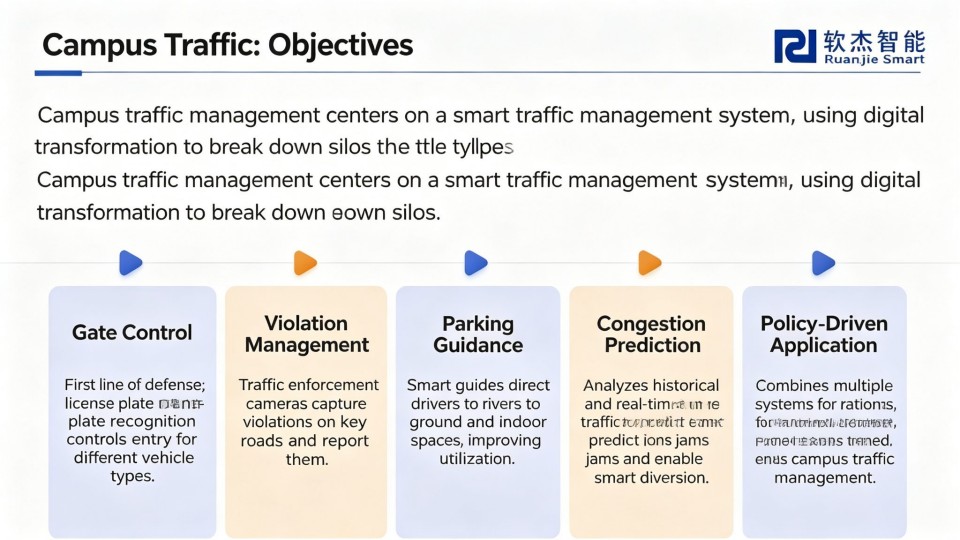
Using the campus traffic-management system as the core and digital transformation as the driver, the solution focuses on gate control,
motor-vehicle violation management, parking guidance, congestion prediction and institutional workflows. The practical objective is “service first, management second.”
2.2 Gate license plate recognition management
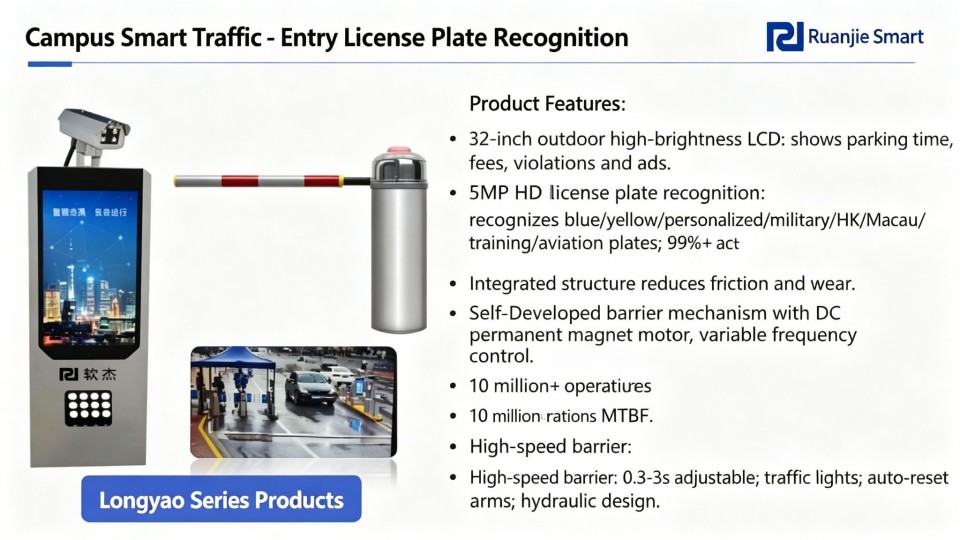
The campus gate is the first line of campus security. The “Longyao” series license plate recognition and barrier-gate system provides efficient passage and precise control.
Core product features:
32-inch high-brightness outdoor LCD display showing parking duration, fee information, violation information and advertisements
5-megapixel HD plate recognition with accuracy of at least 99%, supporting blue, yellow, military, police, diplomatic and consular plates
Self-developed 3D dual-drive spring-free mechanism with at least 10 million fault-free operations
Adjustable operating speed of 0.3–3 seconds and automatic boom-arm reset after impact
Customisable screen content for different campus scenarios
Functional highlights:
Vehicle recognition rate above 99.9%
Customised screen content for welcome and payment information
Violation-linked control, including passing-vehicle prompts, delayed boom lifting and restricted-access control
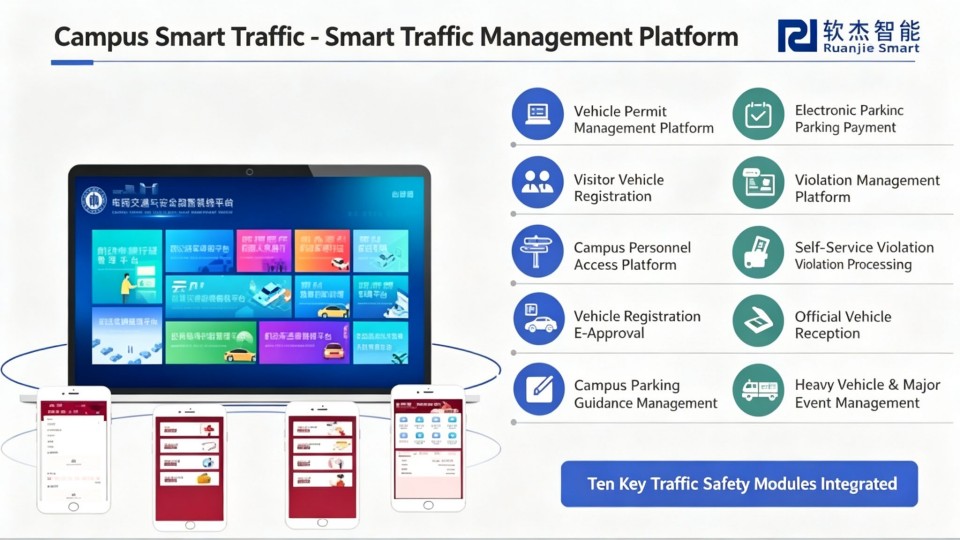
The platform provides an integrated control system with 12 traffic-safety modules:
Motor-vehicle pass management
Vehicle appointment and campus-entry registration
Electronic review of motor-vehicle registrations
Electronic parking-payment management
Self-service processing of vehicle violations
Large-vehicle and major-event management
Campus personnel access management
Smart campus parking guidance
Motor-vehicle violation management
Official-vehicle reception management
Campus vehicle time-penalty management
Data statistics and analysis
2.4 Smart campus parking guidance
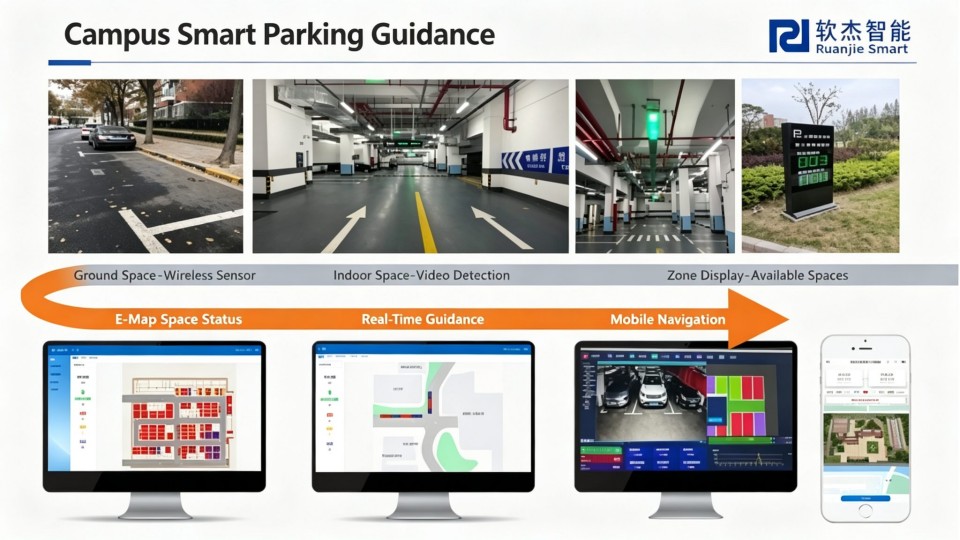
Differentiated detection is provided for surface spaces and garage spaces:
Surface spaces: wireless geomagnetic monitoring
Garage spaces: video space monitoring
Area guidance displays: real-time available-space guidance
Electronic map: visual display of space status
Overtime-parking alerts: prevent resource occupation
Mobile guidance: real-time queries on staff and student phones
2.5 Linked control of motor-vehicle violations
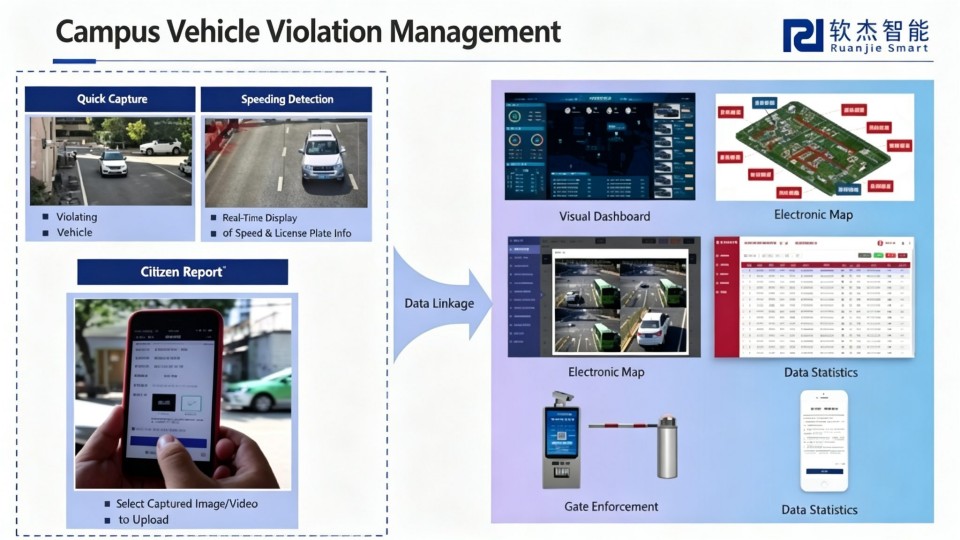
The solution creates a complete violation-control loop:
Speed detection: Displays plate and speed information in real time.
Illegal-parking capture: Automatically captures illegal parking on campus.
One-click vehicle relocation: Supports “snap and report” requests for vehicles parked improperly.
Data linkage: Shows data on a visual dashboard and electronic map and supports collection and reporting.
Gate linkage: Provides passing-vehicle prompts and delayed boom lifting for violating vehicles.
Self-service processing: Supports mobile violation queries, video learning, traffic quizzes and electronic commitments.
三. Integrated crisis intervention and emergency command
3.1 Construction background
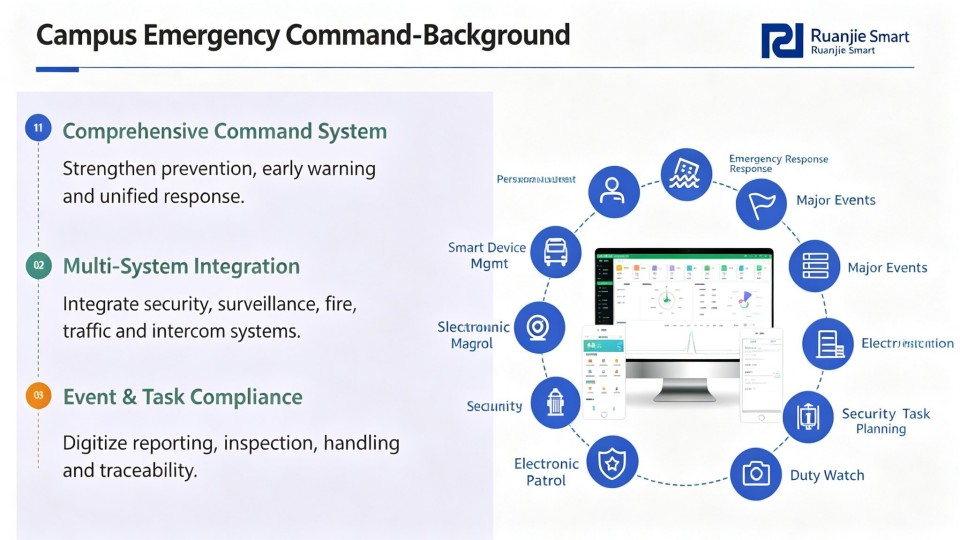
The campus emergency command system covers duty operations, key-facility inspection, security patrols, intelligent asset registers,
major-event management, emergency response, personnel and vehicle control alerts, and fire-safety management.
3.2 Construction approach and priorities
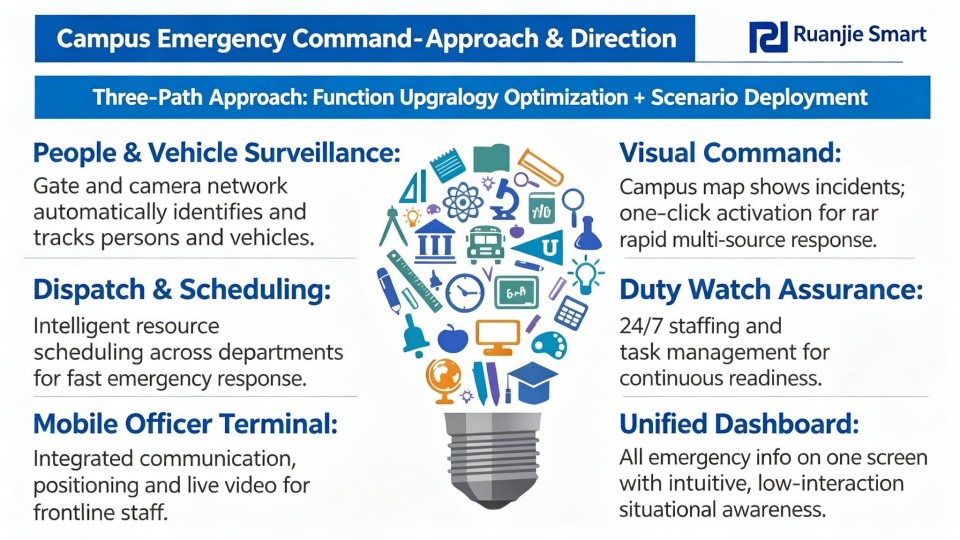
The system follows a three-dimensional path of functional completion, technology optimisation and scenario implementation:
Comprehensive control of key people and vehicles: Link gate barriers with structured campus surveillance,
manage blacklists and greylists and provide real-time alerts for abnormal behaviour.
Visual command linkage: Use the campus electronic map to launch emergency plans and connect multiple resources quickly.
Command and dispatch management: Coordinate across levels and departments to improve response and resource allocation.
Integrated mobile field terminals: Combine communications, positioning and video upload to strengthen front-line response.
Full duty coverage: Provide all-weather emergency response.
One-screen situation awareness: Show key information on one screen for a complete view of the campus situation.
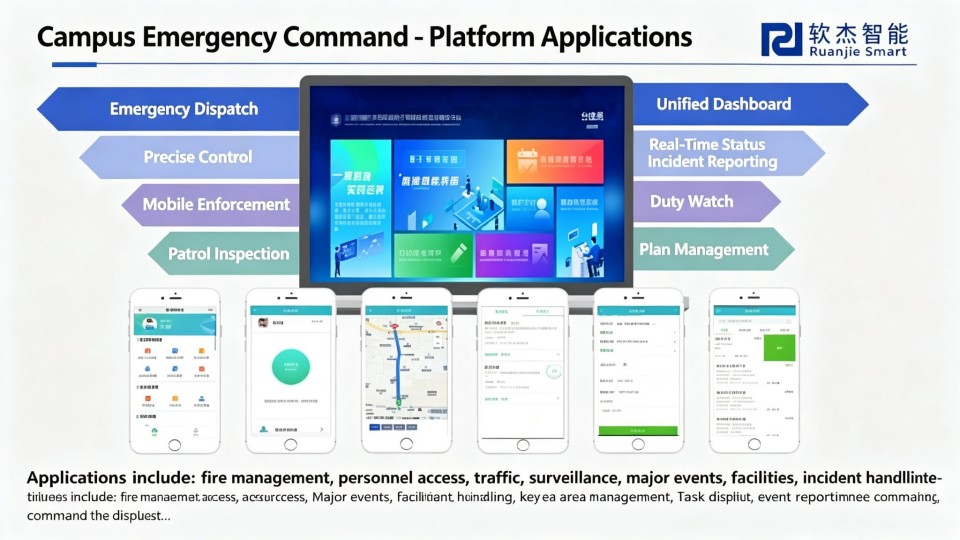
Applications include fire management, personnel access, traffic management, security monitoring, major events,
facilities and equipment, incidents, key areas, task dispatch, incident reporting and command dispatch.
Core modules:
One-screen overview and real-time situation awareness
Incident reporting and intake
Duty and watch management
Emergency-plan control
Emergency command and dispatch
Precise control and alert management
Mobile field enforcement
Patrol and inspection
3.4 Integrated campus field enforcement
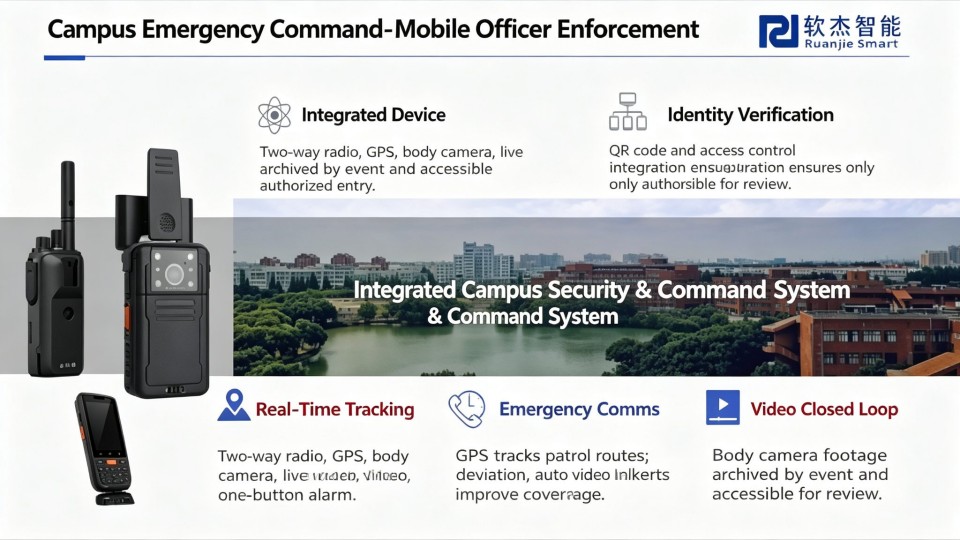
The system creates an integrated campus-security field-command structure:
Integrated terminal functions: Combine gate duty, patrol management and enforcement records for multiple scenarios.
Precise identity verification: Supports QR codes, identity-card reading and linkage to the campus source-code verification system.
Real-time positioning: Built-in GPS uploads patrol tracks and warns when personnel leave an assigned area.
Emergency communications: One-click calls, group intercom and real-time enforcement-video upload.
Closed-loop video management: Stores recordings by terminal number, time and incident type, with six months of data retention.
3.5 Precise control of people and vehicles
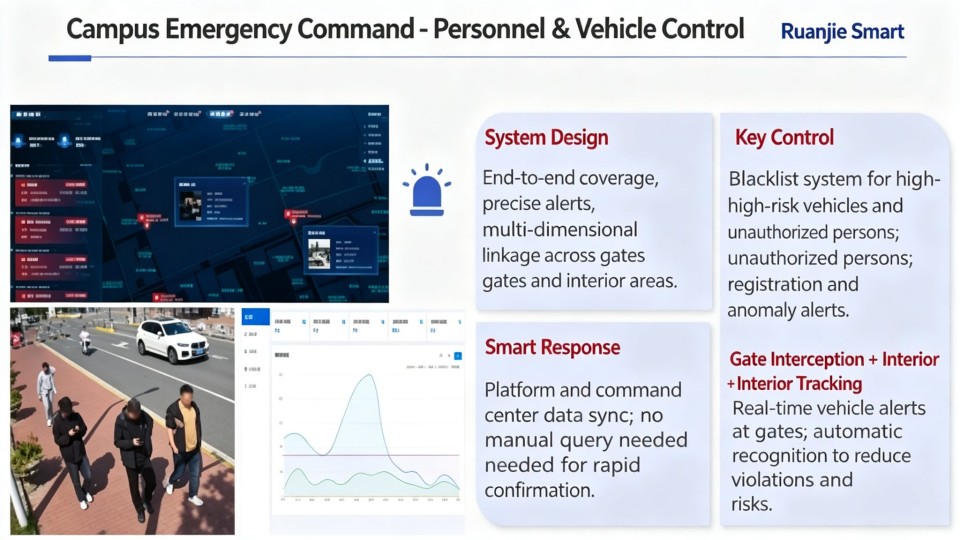
The system links the campus gate and internal areas into one control model:
Key-target control: Creates black- and greylist groups linking people, vehicles and areas, with differentiated high-, medium- and low-risk control.
Dual prevention: Combines gate interception with internal tracking and uses structured video surveillance to monitor movement throughout the campus.
Smart emergency linkage: Shares data between the control system and the emergency command platform for rapid response.
3.6 One-screen overview
The platform integrates campus security, fire safety, personnel access, incidents and smart traffic data. Static,
dynamic and trend data are aggregated in real time for a complete one-screen view, enabling visible safety conditions, predictable risks and controlled response.
3.7 One-map emergency command
The whole-campus electronic map displays campus areas, emergency security teams, vehicles and security equipment.
Security personnel and patrol vehicles can be located in real time. Intercoms, body-worn cameras and other terminals support one-click dispatch,
dynamic resource tracking and closed-loop task feedback.
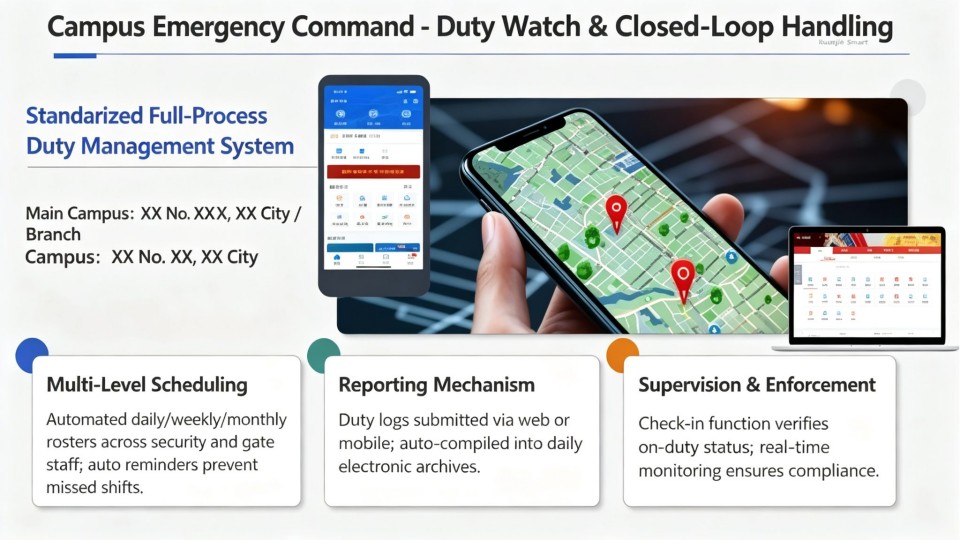
3.8 Duty operations and incident-response loop
Multi-level scheduling: Preset daily, weekly and monthly shifts, automatically assign personnel and push notifications.
Information reporting: Link duty logs with alerts and equipment status to form a complete electronic record.
Duty supervision: Use location-based sign-in and attendance to monitor on-duty status.
Emergency plans: Configure plan models and task templates; different emergency levels trigger different response processes.