Integrated Smart Parking Solution for Industrial Parks
Turn parking management from a cost centre into a profit centre
1. Smart parking solution
Intelligent entrance and exit fee management
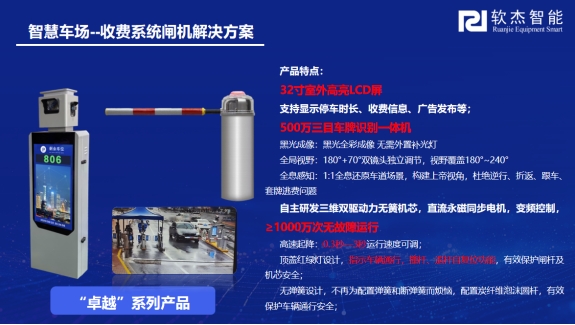
The entrance and exit are the first control points in a park's parking operation. This solution combines a three-camera license plate recognition all-in-one unit
with a 3D high-speed barrier gate for unattended operation across the entire site.
Core hardware features:
5-megapixel triple-camera recognition with colour imaging in low-light conditions and no external fill light
Independently adjustable 180° and 70° lenses, with a 180°–240° field of view
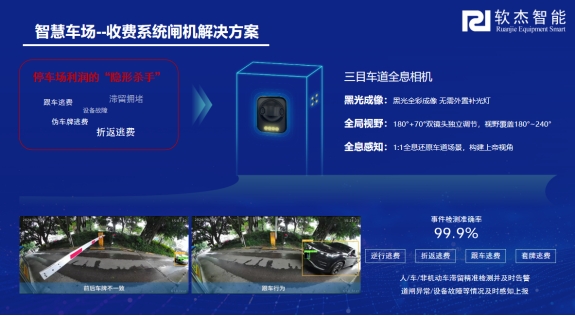
1:1 holographic reconstruction of the lane scene with a top-down view to prevent wrong-way travel, turnarounds, tailgating and cloned-plate fee evasion
Self-developed 3D dual-drive spring-free mechanism with at least 10 million fault-free operations and adjustable 0.3–3-second speed
HDR wide-dynamic-range processing
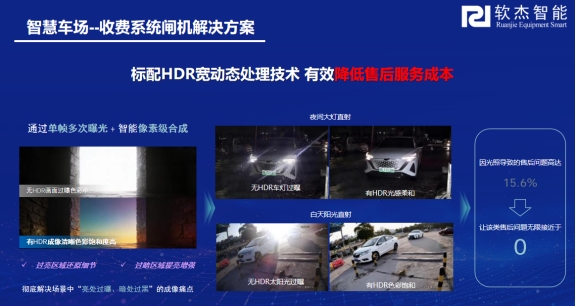
HDR is standard. Multiple exposures in one frame and intelligent pixel-level compositing resolve overexposure from headlights at night and sunlight during the day,
keeping plates clear and stable in all conditions.
Precise AI sensing of abnormal events**
With a reported event-detection accuracy of 99.9%, the system identifies wrong-way travel, turnarounds, tailgating and cloned-plate fee evasion.
It also detects people, vehicles and non-motorised vehicles left in an area and reports equipment faults.
Protection against power and network outages
Dual 4G backup: switches to 4G automatically within five seconds after a wired-network failure
Mobile handheld terminal: offline plate capture, recognition, fee calculation and remote gate control through a mobile app
Power-outage module: opens the gate automatically during a power failure to keep traffic moving
24/7 cloud service seat
Audio and video intercom, cloud plate verification and remote gate opening and closing support genuinely unattended operations and lower labour cost.
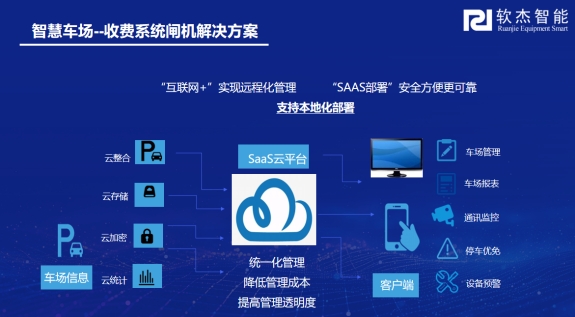
SaaS cloud platform
Supports local deployment and provides car-park reports, equipment alerts, parking discounts and free-parking rules, and centralised management for transparent, efficient operations.
Parking-space management
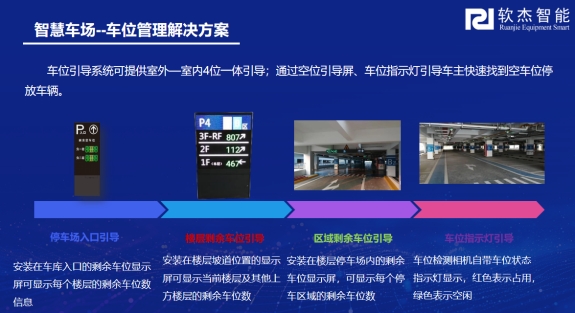
The solution offers video, geomagnetic, ultrasonic and radar detection for different scenarios.
Four-level guidance system:
Car-park entrance guidance: shows remaining spaces on each floor.
Floor-ramp guidance: shows remaining spaces on the current and upper floors.
Area guidance: shows remaining spaces in each parking area.
Space indicator guidance: red means occupied and green means available.
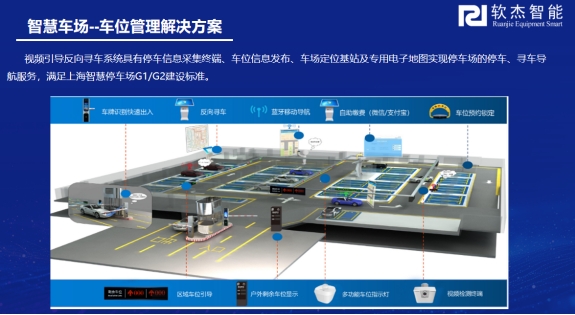
Reverse vehicle finding
Bluetooth positioning supports dynamic navigation and real-time route planning. Voice navigation and AR panoramic video
navigation are available as options and support G2-level navigation requirements.
Ride-hailing management
License plate recognition and space control support order-based release, data exchange and convenient ride-hailing management and passenger vehicle finding.
2. Holographic car park and AI enablement
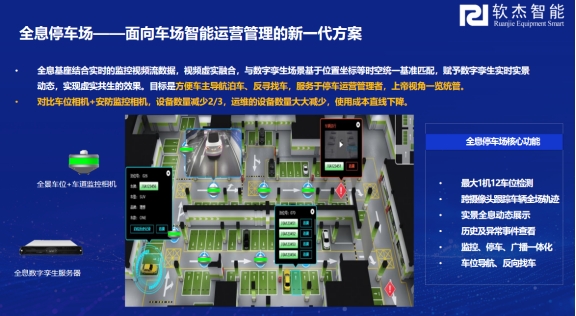
Digital-twin holographic car park
The system senses the physical car park and recreates it at a 1:1 scale as an accurate, real-time digital twin.
Core functions:
One unit detects up to 12 spaces.
Tracks vehicle movement across cameras throughout the site.
Displays a dynamic holographic view of the real scene.
Replays historical and abnormal events with one click.
Integrates monitoring, parking and broadcasting.
Supports space navigation and reverse vehicle finding.
Three synchronisation technologies
| Dimension | Technical metric |
|---|
| Time synchronisation | Synchronous exposure of sensing sources < 1 ms |
| Spatial synchronisation | 3D positioning accuracy < 50 cm |
| Data synchronisation | Sensing-source latency < 100 ms |
Advantages over conventional systems
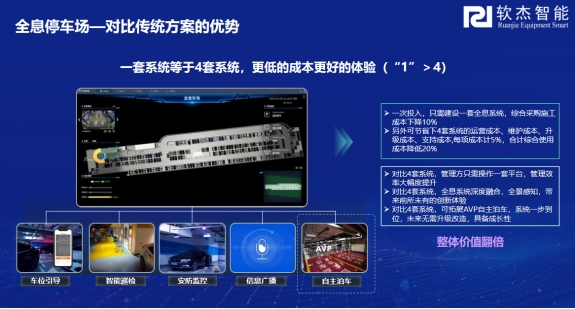
One holographic system replaces four systems: parking guidance, intelligent inspection, information broadcasting and security monitoring.
Combined procurement and construction cost is reported to fall by 10%, and operating cost by 20%. Operators use one platform, improving efficiency.
The architecture also reserves the option for AVP autonomous parking without a future system rebuild.
Advantages over Traditional Solutions
One holographic system integrates four systems: parking guidance, intelligent patrol inspection, information broadcasting and security monitoring.
It reduces combined procurement and installation costs by 10% and operating costs by 20%.
Management personnel only need to operate one platform, greatly improving management efficiency.
The system can also be expanded to support AVP automated valet parking, eliminating the need for future system upgrades or retrofit work.
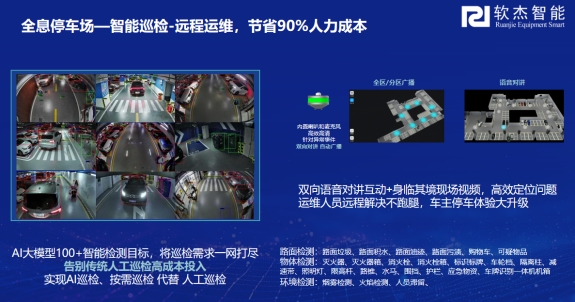
AI intelligent inspection
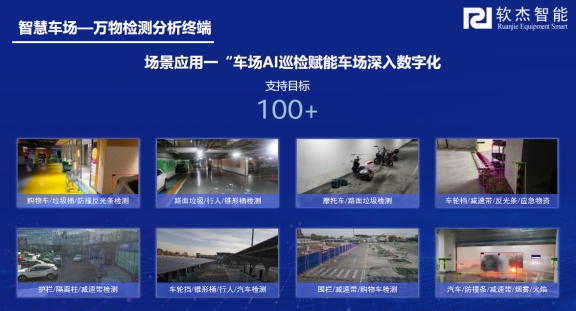
An AI large model supports more than 100 detection targets, including roadside rubbish, standing water, facility abnormalities, smoke and flames, and people remaining in an area. It replaces manual patrols and can save up to 90% of labour cost. Built-in speakers and microphones support two-way intercom and automatic broadcasting so maintenance staff can resolve issues remotely.
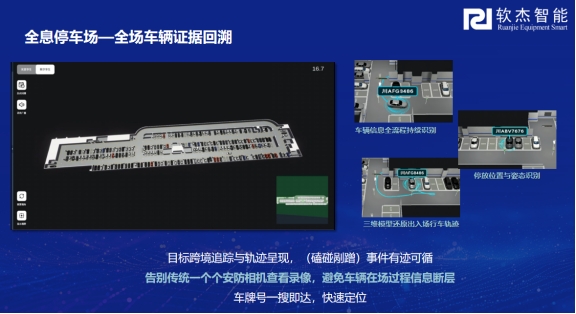
Site-wide vehicle evidence replay
Vehicle information is recognised continuously, and targets are tracked across cameras. Scrapes and collisions can be traced. Instead of reviewing security video one file at a time, operators can search a plate number and locate the relevant evidence quickly.
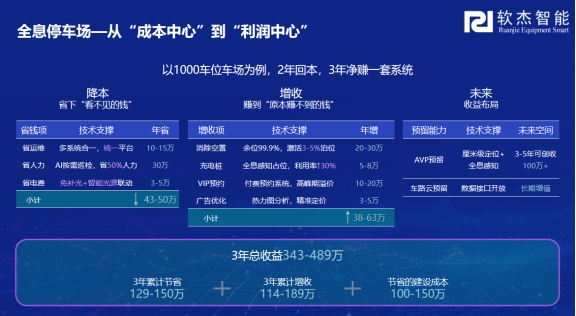
From cost centre to profit centre
For a 1,000-space car park, the source page presents a two-year payback and a net system-equivalent return after three years.
Annual cost reduction: RMB 430,000–500,000
| Saving area | Technical support | Annual saving |
|---|
| Maintenance | Multiple systems combined on one platform | RMB 100,000–150,000 |
| Labour | AI inspection on demand; 50% less labour | RMB 300,000 |
| Electricity | No fill light plus smart light-source linkage | RMB 30,000–50,000 |
Annual revenue increase: RMB 380,000–630,000
| Revenue area | Technical support | Annual increase |
|---|
| Reduce vacant capacity | 99.9% availability information activates 3–5% of spaces | RMB 200,000–300,000 |
| Charging | Holographic occupancy sensing raises utilisation by 30% | RMB 50,000–80,000 |
| VIP reservations | Paid reservations with peak-period premium pricing | RMB 100,000–200,000 |
| Advertising optimisation | Heat-map analysis supports precise pricing | RMB 30,000–50,000 |
Future revenue options include AVP readiness (centimetre-level positioning and holographic sensing, with a reported potential to generate more than
RMB 1 million over three to five years) and vehicle-road-cloud readiness through open data interfaces.
Multi-object detection and analysis terminal AIBOX
The AIBOX uses an eight-core 64-bit RISC CPU and 16/64T of PanGu AI computing power. Its local algorithm library contains more than 100 algorithms,
with more than 30 available for flexible activation. It supports car-park AI inspection, charging-station management and security monitoring,
helps prevent internal-combustion-engine vehicles from occupying charging spaces and improves site safety.